Saṅgha Night
Sangha Night is our weekly class for those who are familiar with the practices we teach and have been attending our activities for a while. Together we look at ways the teachings can be taken more deeply into our lives.
Buddhism is not a static set of beliefs but a living tradition that has evolved continuously for over 2,500 years. Over the next six weeks (1 June – 22 July) we're exploring ‘The Living Dharma: Four Paths to Awakening’. This series investigates how the Buddha's teachings developed into the rich diversity of Buddhist schools and practices we encounter today.
Beginning with dependent arising and emptiness, we will trace the unfolding of the Dharma through great teachers, lineages, and traditions, before exploring four powerful approaches to awakening: self-development, self-surrender, self-discovery, and self-emergence. Together we will discover how these different paths illuminate both the history of Buddhism and our own spiritual lives.
Each evening will include guided meditation, enquiry and discussion, with space for questions and reflection.
Everyone is welcome, however for newcomers another weekly class (such as Tuesday evenings) may be more suitable.
Programme
17 June 2026: Week 1 — The Living Dharma: From Conditionality to Emptiness
Tracing a living lineage from the Buddha’s teaching of conditionality to the practices we engage in today.
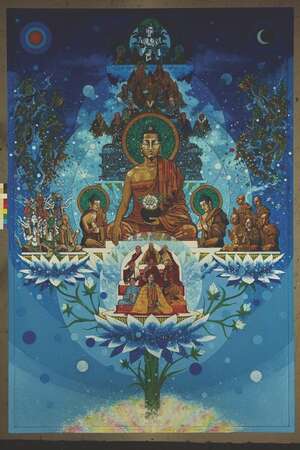
24 June 2026: Week 2 — Teachers, Lineage and the Triratna Refuge Tree
Exploring the spiritual ancestry of our practices and the mythic imagination that carries the Dharma through time.
1 July 2026: Week 3 — The Myth of Self-Development
The path of personal effort, discipline and transformation.
8 July: Week 4 — The Myth of Self-Surrender
Faith, devotion and opening to forces greater than the ego.
15 July: Week 5 — The Myth of Self-Discovery
Purifying obscurations and uncovering the awakened heart.
22 July: Week 6 — The Myth of Self-Emergence
Recognising the ever-present nature of awareness and positive emotion.
Frequently Asked Questions
Is it okay to join the middle of a series?
Absolutely! You'll get those most out of the class by attending the whole series, but you can come along anytime.
What is pūjā?
A pūjā is a traditional Buddhist ritual that includes chanting and making offerings.
If coming on a pūjā night and you have not done it before, please let one of the team know so they can give an introduction.
How long do I need to have been coming?
This evening is best suited for those who are familiar with the practices we teach and have been attending our activities for a while. A good measure would be if you have attended an entire cycle of talks on Newcomers Night.
I can't make it to any of the introductory classes, can I come to this class instead?
Since the meditation practice is usually with minimal instruction, and the topics covered are quite in depth, this class is not well suited for newcomers.
Can I come just for the meditation?
Of course!
How much does the class cost?
We don't charge a fixed price for our classes but instead invite you to make a donation to the centre to help us cover our running costs.
A donation of $10-20 would help us to cover our costs, but everyone is equally welcome, even if you cannot give anything at all.
The Team


